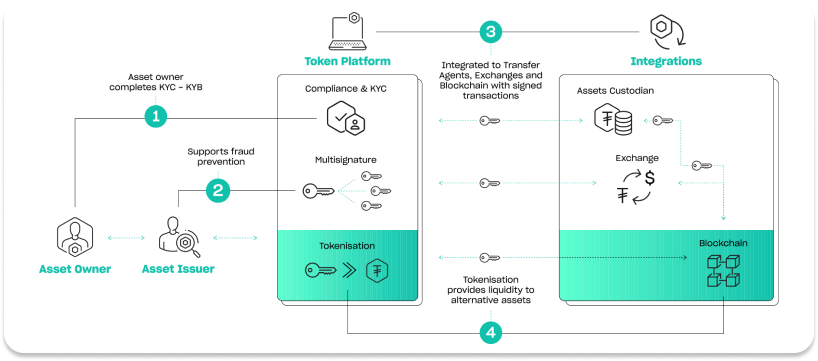
Traditional financial infrastructure often forces institutions to endure $T+2$ settlement cycles, manual reconciliation, and fragmented record-keeping. These friction points delay transactions, trap capital, and increase operational overhead. Hadron by Tether materially reduces these legacy inefficiencies with a synchronized, shared-ledger environment.
By moving to a blockchain-native infrastructure, issuers can launch new products—from fiat-collateralized stablecoins to commodities or real estate—in weeks rather than the 12 to 18 months required for proprietary solutions. Adopting Hadron by Tether replaces manual administration with automated financial workflows.
This guide provides the roadmap to modernize your infrastructure, ensuring your team spends less time reconciling spreadsheets and more time managing value.
The Operational Shift
Legacy Workflow vs. Hadron Workflow
To understand the value of Hadron by Tether, we contrast the current fragmented state with the unified model.
The Value of Atomic Settlement ($T+0$)
On Hadron by Tether, data movement is financial settlement. By moving to an asset tokenization workflow, institutions consolidate issuance, compliance, and settlement into a single layer. This eliminates the 48-hour waiting period, frees up trapped capital, and removes the need for manual reconciliation between investor ledgers and bank balances.
Your Pre-Flight Checklist
Before beginning the onboarding process, ensure your team has the following elements prepared to minimize delays during technical setup:
Legal Entity Documentation: Articles of incorporation and verified status for the issuing entity.
Authorized Signatories: A defined list of officers authorized to execute the multi-signature signing ceremony.
KYC/KYB API Integration: Details for your current Know Your Customer and Know Your Business providers.
Token Economic Parameters: A clear definition of supply logic (fixed vs. elastic), yield distribution logic, and jurisdictional scope.
The Onboarding Workflow
Strategic Definition: Define the asset class (e.g., real estate, commodities, or stablecoins) and economic parameters.
Technical Integration and Account Setup: Configure multi-signature wallets. Hadron by Tether utilizes a non-custodial architecture, ensuring the issuer retains direct control over the private keys, while the custody and management of underlying off-chain reserves are governed by the issuer’s independent legal and custodial arrangements.
Data Standardization & Metadata: Map your prospectus and legal terms of service to the smart contract metadata, intending for the digital token to carry the same legal weight as a paper certificate.
Compliance & FAQ
Programmatic Compliance Logic
The platform programmatically prevents unauthorized or sanctioned wallets from transacting, shifting the burden from manual monitoring to automated prevention.
What happens if a signatory loses a private key? The platform’s multi-signature architecture prevents single points of failure through quorum-based approvals.
How does this sync with internal accounting? Real-time reporting dashboards and APIs feed data directly into your existing ERP or treasury management systems.
Does this replace my legal counsel? No. The smart contract programmatically enforces rules, but does not absolve the issuer of independent regulatory obligations or due diligence.
Conclusion
Onboarding to Hadron by Tether integrates new infrastructure into existing operations. By adopting this tokenization workflow, institutions replace manual tasks with automated, software-driven processes. The platform’s architecture minimizes the operational complexity typically associated with blockchain implementation. CFOs and asset managers gain increased liquidity and operational efficiency without altering their fundamental business structures. This technology provides automated, software-based enforcement of existing financial regulations and compliance requirements.
Get Started
To begin your institutional onboarding, or to discuss how Hadron by Tether can be tailored to your specific asset requirements, please contact our team to schedule a technical evaluation.
Stablecoin issuers operating in regulated environments require technical infrastructure that can enforce governance, maintain transparent reserves, and support monitoring risk in near real time. The Hadron by Tether platform, with Chainalysis monitoring integrated directly into its marketplace, provides tools that facilitate controlled minting, secure issuance processes, and continuous monitoring for institutions operating within regulated environments.
Quantoz Payments B.V., a Dutch Electronic Money Institution supervised by the Dutch Central Bank and the Dutch Authority for the Financial Markets, has emerged as one of Europe’s leading issuers of MiCAR-compliant stablecoins. Using the Chainalysis-integrated marketplace on Hadron by Tether, Quantoz issues fully-backed e-money tokens that deliver near instant settlement, regulatory assurance, and enterprise-ready stability.
This case study highlights how Quantoz uses Hadron by Tether to mint, manage, and safeguard its EURQ and USDQ stablecoins while leveraging Chainalysis for near real-time compliance monitoring across global markets.
About Quantoz
Founded in 2015, Quantoz began as a blockchain settlement technology provider for corporates and financial institutions. In 2021, the company launched Quantoz Payments B.V., obtaining an Electronic Money Institution (EMI) license from the Dutch Central Bank (DNB). The firm later introduced EURD, EURQ, and USDQ, fully backed MiCAR-compliant e-money tokens designed for transparent, responsible, and scalable digital payments.
Quantoz maintains a unique regulatory position as:
Operating under direct supervision from DNB and the Dutch Authority for the Financial Markets
Maintaining reserve safeguarding through Quantoz Foundation, a bankruptcy-remote entity
Requiring 100% reserve backing + an additional 2% own funds capital buffer
Since launching EURQ and USDQ in November 2024, Quantoz has achieved over $9 billion in cumulative trading volume across 70+ global exchanges, positioning its stablecoins among the fastest-growing regulated digital currencies in Europe.
Why Hadron by Tether
Quantoz selected Hadron by Tether to serve as the secure issuance and governance layer for its stablecoins. Hadron by Tether provides institutional-grade controls for minting, burning, and reserve management, enabling Quantoz to meet stringent MiCAR and DNB requirements while maintaining operational efficiency.
Key Benefits for Quantoz
Secure governance.
Multi-signature authorization and role-based controls intended to ensure minting and burning actions are properly governed.
Cross-chain interoperability.
Hadron by Tether supports issuance on Ethereum, Polygon, and other major networks, enabling Quantoz to expand across multiple ecosystems.
Institutional custody and reserve controls.
Integration with Nexus, Quantoz’ blockchain-native core banking platform, provides strict segregation of duties and transparent reserve account management.
Full auditability.
Records every operational action—minting, burning, approvals, transfers—creates a complete audit trail designed to support internal reviews and regulatory reporting.
Operational efficiency.
The platform allows both technical and non-technical team members to execute secure, governed actions without manual blockchain operations.
Integration with Chainalysis
Quantoz uses Chainalysis as a critical component of its compliance and risk-management processes. EURQ and USDQ are continuously monitored for compliance and investigations.
Monitoring and AML/CFT compliance.
Chainalysis KYT provides visibility into wallet behavior, transaction flows, and counterparty exposure to illicit activity, helping Quantoz assess risk of both direct and indirect stablecoin transactions. If an alert is triggered, Quantoz can examine the transaction details, manage the alert through case management, and take appropriate action in near real time.
Actionable intelligence.
When higher-risk patterns emerge, Chainalysis Sentinel provides Quantoz a holistic view of its stablecoin ecosystem, showing categories and holders of their token and enabling them to quickly prioritize and investigate using Chainalysis Reactor to protect users and maintain strong operational controls.
Regulatory alignment with MiCAR.
Chainalysis supports Quantoz in meeting MiCAR’s transparency and ongoing monitoring requirements, reinforcing trust among exchanges, enterprises, and institutional partners.
“At Chainalysis, our mission is to bring greater transparency and trust to the digital asset ecosystem. Our collaboration with Hadron by Tether strengthens the security and compliance foundation of RWAs and stablecoins by equipping issuers and platforms with the intelligence they need for real-time monitoring, risk analytics, and investigations. Together, we’re enabling the stablecoin ecosystem to scale responsibly.” —Shannon Hughes, Senior Director, Head of Business Development and Partnerships, Chainalysis
Stablecoin Issuance on Hadron by Tether
Quantoz issues its stablecoins with full reserve backing and controlled governance through Hadron by Tether.
Tokens issued:
EURD (June 2024; closed-loop)
EURQ (November 2024)
USDQ (November 2024)
Market footprint:
Listed on 70+ exchanges including Kraken, Bitfinex, Bitpanda, Bybit, Digifinex, BitMart
Active on multiple blockchains
Over $9 billion in cumulative trading volume since launch
Over $50 million USDQ minted via Hadron by Tether to reserve accounts
Hadron by Tether supports that every token minted is being matched with fiat reserves safeguarded by Quantoz Foundation, enabling transparency, security, and regulatory consistency.
Workflow: From Onboarding to Redemption
Quantoz’s stablecoin lifecycle on Hadron by Tether supports a governed, compliant, and auditable process consistent with EU regulatory expectations.
1. Client Onboarding and Compliance
Full KYC/AML checks for institutional clients and liquidity partners
Bank account verification and reserve flow validation
Controlled role assignments within Hadron by Tether
2. Reserve Funding
Fiat sent to Quantoz Foundation for safeguarding
Assets held in cash and short-duration instruments
Reserves verified before any token issuance
3. Minting on Hadron by Tether
Quantoz initiates a mint request through the platform
Multi-signature approvals executed via Nexus
Tokens minted to Quantoz’s governed reserve account
4. Distribution
Transfers to exchanges or enterprise clients
All transactions logged with full auditability
Compliance rules enforced programmatically
5. Monitoring and Risk Management
Continuous monitoring of wallet flows and token activity via Chainalysis
Automated alerts for suspicious activity
Enhanced reporting to support MiCAR and DNB standards
6. Redemption and Burning
Users redeem tokens for fiat at par
Quantoz processes withdrawal via its EMI-regulated safeguarding structure
Corresponding tokens are burned on Hadron by Tether, maintaining 1:1 backing
7. Reporting
Combined Hadron by Tether and Chainalysis data supports supervisory reporting
All mint/burn operations preserved for regulatory audits
Adoption and Market Impact
Quantoz’s regulated stablecoins have quickly gained traction across payments, trading, and corporate finance.
Key Use Cases
Cross-border payments.
Near-instant settlement between Europe, Asia, and the Middle East.
Corporate treasury and liquidity operations.
Programmable, 24/7 stablecoin infrastructure improving reconciliation and settlement cycles.
Merchant payments.
Multiple Partners are in the process of implementing EURQ and USDQ for retail transactions.
Exchange liquidity and market access.
Listings across 70+ exchanges have driven rapid volume growth and global accessibility.
Impact of MiCAR Compliance
MiCAR provides clarity on issuance, safeguarding, and governance—an environment where Quantoz’s regulatory-first model thrives. Businesses seeking stability, transparency, and oversight increasingly view MiCAR-regulated e-money tokens as preferred settlement tools for high-volume commercial operations.
Roadmap
Quantoz plans to expand its stablecoin ecosystem across new markets and blockchains over the next 12–24 months. Upcoming initiatives include:
Wider enterprise integrations across payments, ecommerce, and treasury platforms
Expansion of EURQ and USDQ across additional European corridors
Growth of on-chain liquidity and cross-network interoperability
Enhanced reporting and risk-management features coordinated with Chainalysis
Multi-chain issuance expansion supported by Hadron by Tether
Conclusion
Quantoz’s use of the Chainalysis-integrated marketplace on Hadron by Tether sets a new standard for regulated stablecoin issuance in Europe. By combining secure token governance, transparent reserves, and real-time risk intelligence, Quantoz demonstrates how MiCAR-compliant digital money can operate at scale with ongoing regulatory alignment.
This collaboration showcases the future of regulated financial infrastructure, where programmable money, continuous monitoring, and institutional governance converge to support global commerce.
This case study demonstrates how blockchain infrastructure is transforming microfinance funding into a scalable and compliant digital asset ecosystem.
In markets with limited access to finance, Mikro Kapital finances underserved micro-entrepreneurs and small businesses, about 40% of which are led by women. Their tokenized bond program, Alternative, provides a reliable and transparent funding source that supports job creation and local economic resilience.
The first tranche of the tokenized bond program was issued in December 2023 by Alternative, the securitization entity of Mikro Kapital. The capital raise and secondary market listing for all tranches took place on Bitfinex Securities under its license in the Astana International Financial Centre (AIFC). Since then, the program has continued through the issuance of a series of additional tranches. The listing on Bitfinex Securities broadened investor access and streamlined operations, connecting Mikro Kapital with global investors and digital-asset-focused participants who would otherwise have had limited access to private credit opportunities. Investors were able to withdraw and self-custody their holdings, transact in USDT for integration with the global digital asset ecosystem, and access a regulated secondary market for trading through Bitfinex Securities.
The technology to enable the listing was provided by Hadron by Tether.
Hadron by Tether: Platform Overview
Hadron by Tether is a real-world-asset (RWA) tokenization platform that allows institutions to tokenize equities, bonds, commodities and other alternative assets. Its core features include:
Modular issuance tools with issuer-configurable metadata, permissions and fractionalization.
Cross-chain deployment and high throughput, with primary usage on Bitcoin’s Liquid Network as well as multiple leading blockchains.
Bitfinex Securities: Platform Overview
Bitfinex Securities operates a regulated platform for the primary issuance and trading of tokenized securities and RWAs, holding the first licenses for these activities in both the Astana International Financial Centre (AIFC) in Kazakhstan and El Salvador. The platform enables issuers to raise capital through tokenized asset issuances, providing investors worldwide with access to high-quality assets, 24/7 trading, real-time settlement, and the ability to withdraw, self-custody, or transfer tokenized assets, as well as integration with digital asset markets through Bitcoin and Tether.
The role of Bitfinex Securities in these issuances includes:
Supporting capital raises and secondary market trading
KYC/AML of the issuer and all investors
Providing the licensing framework to facilitate the issuance
Executing dividend and principal payments
Key Technical Capabilities
This section outlines the core features that support regulated tokenized securities.
Confidential & secure issuance
The family of Alternative bonds is designated ALT2612, ALT11M2507, ALT11M250830, and ALT11M251029. Using confidential transactions, ensuring both privacy of financial details and compliance with regulated frameworks. These were issued on the Liquid Network by Bitfinex Securities. Hadron by Tether interoperates with Liquid and provides parallel services.
Coupons and token fractionalization
Each tranche was structured as digital tokens with $100 denominations, enabling broader accredited investor participation. The issuer deposited USDT to their BFXS capital raise account. It was then deducted from that account and credited to the investor accounts.
Compliance and smart-rail whitelisting
Transfer restrictions enforce that only verified wallets may hold or trade tokens. The whitelist is maintained by Bitfinex Securities and the issuer via Blockstream AMP metadata.
API-driven lifecycle management
Whitelisting and redemption processes are automated through Hadron by Tether’s APIs and the Liquid protocol.
Workflow: From Issuance to Maturity
This workflow shows the full lifecycle—from onboarding and token setup through coupon payments and redemption—managed end-to-end on-chain.
Alternative Tokenized Bond Issuance Overview
Thefamily ofAlternativetokenizedbond issuances includes ALT2612, ALT11M2507, ALT11M250830, and ALT11M251029. Alternativeprovides a tangible example of Hadron by Tether’s capabilities in action.
ALT2612, launched in December 2023, carried a 10% annual coupon with a 36-month maturity and raised about $5.2 million.
The 11-month series (ALT11M2507, ALT11M250830, ALT11M251029) have coupon rates between 9% and 9.5% and are each structured for up to 10 million USDT.
All issuances share core features: programmatic coupon execution, fractional token denominations, and whitelist-enforced trading under regulated frameworks.
Tokens are issued in USDT-denominated units, structured via the Blockstream AMP compliance framework, with metadata specifying investor permissions and transfer restrictions.
These bonds successfully completed their full life cycle, maturing and returning principal to investors.
This model shows how tokenized bonds can be issued in multiple tranches while maintaining consistent efficiency, compliance, and transparency.
Note: Settlement speed, investor counts and trading volumes were not publicly disclosed. Investor segmentation is limited to accredited categories under Bitfinex Securities’ rules and MiFID-aligned jurisdictions.
Platform Advantages vs. Traditional Issuance
Compliance, Risk & Security Architecture
Inclusion & Investor Impact
Ecosystem Use Cases & Scalability
Mikro Kapital’s Alternative bond issuances demonstrate that tokenized bonds can be structured as a coordinated program under a consistent technical and regulatory framework. This approach proves that regulated digital securities can be scaled efficiently across multiple offerings.
The program also advances Mikro Kapital’s mission by directing capital to underserved micro-enterprises, including many women-led businesses, and supporting economic inclusion in regions with limited access to finance.
From a technical standpoint, the bond structure can be adapted for future instruments such as basket tokens, commodity-backed products, and structured yield offerings. Each issuance leverages the same infrastructure, allowing the program to grow across maturities, volumes, and asset classes while maintaining compliance and efficiency.
Roadmap & Outlook
Mikro Kapital’s Alternative tokenized bond issuances demonstrate that regulated digital securities can scale beyond individual tranches into a repeatable and sustainable financing program. Looking forward, the roadmap combines platform enhancements with broader market adoption to ensure that future issuances expand in scope, efficiency, and reach.
Planned platform enhancements include:
Multi-currency issuances (EURT, MXNT, and others)
Dynamic couponing and refinancing capabilities
Expanded secondary trading interfaces
Custodian and compliance integrations, with optional DeFi connectivity
From a market perspective, further development will focus on cross-jurisdictional expansion, increased institutional participation, and the ability to monitor on-chain trading volumes and investor activity across tranches. These advancements reinforce how tokenized bond issuances can serve as a long-term financing mechanism for impact-focused institutions while broadening investor access to regulated digital assets.
This case study is provided for informational purposes only and does not constitute financial, investment, or legal advice. The content has been prepared in collaboration with a market participant and is intended to illustrate the use of tokenized securities in regulated markets. Readers should consult with their own advisors before making any investment or financial decisions.
As global institutions tokenize assets, speed, confidentiality, and scalability are non-negotiable. The Liquid Network, a Bitcoin Layer 2 sidechain developed by Blockstream, delivers a production-ready framework for secure, fast, and programmable financial markets. Integrated with Hadron by Tether, Liquid enables real-time issuance and settlement of tokenized assets, from sovereign bonds to commodity-backed tokens, through the platform’s robust functionality.
What Is the Liquid Network?
Liquid is a federated Bitcoin sidechain designed for institutions, exchanges, and issuers. It offers:
One-minute block times: Near-instant final settlement in ~2 minutes.
Confidential and auditable: Blind transaction amounts and asset types preserve sensitive financial data of investors while allowing issuers to unblind transactions to meet regulatory requirements.
Issued Assets: A protocol for creating custom tokens, such as securities, stablecoins, or commodities.
Bitcoin-native interoperability: Bitcoin (BTC) can be locked on-chain and converted 1:1 into LBTC for use on Liquid, with support for atomic swaps between other Bitcoin L2s, like Lightning.
By offering additional features without compromising Bitcoin’s foundational integrity, Liquid serves as a specialized infrastructure layer for institutions seeking to build scalable, secure RWA solutions on Bitcoin. Hadron by Tether supports seamless integration with the Liquid Network.
Why It’s Built for RWA Tokenization
Liquid’s UTXO-based design, inherited from Bitcoin, brings essential security and privacy advantages for institutions. Unlike account-based systems, which expose balances and rely on complex smart contracts, UTXO-based systems enable features like multi-signature policies and atomic swaps natively, reducing attack surfaces and limiting exploit risk.
Privacy is also significantly enhanced: wallets generate new addresses for each transaction, shielding balances and trading activity from public view. Confidential Transactions on Liquid further protect sensitive data by hiding asset types and transaction amounts, while still supporting compliance through tools like Blockstream’s AMP, integrated into Hadron by Tether.
Speed is especially critical for RWA tokenization because institutional assets, such as bonds, treasuries, or commodities, often require rapid settlement to meet market, regulatory, or liquidity demands. Liquid’s one-minute block times and potential add-ons, like zero-conf, enable timely execution and reduce counterparty risk, making it well-suited for financial instruments that demand both speed and certainty.
Real-World Applications
Hadron by Tether enables a range of innovative RWA tokenization projects on Liquid:
Tether’s USD₮: Issued on Liquid for fast, confidential stablecoin transactions
Bitfinex Securities: Launched tokenized bonds (e.g., ALT2612) for institutional investors
Other potential Liquid applications through Hadron by Tether include:
Fractionalized real estate with private ownership details
Tokenized venture capital or equity shares with compliance controls
Commodity-backed stablecoins for global trade
Sovereign bonds: A sovereign entity could issue $100 million in Bitcoin-collateralized bonds to enable private pricing, near-instant settlement, and compliant transfer restrictions, entirely within a Bitcoin-native framework
Why Institutions Trust Liquid
The Liquid Federation governance framework ensures high reliability, with globally distributed functionary operators securing the network, so there is no single point of failure. Its Bitcoin-native design appeals to institutions that trust Bitcoin’s battle-tested ecosystem but need advanced features like confidentiality and deterministic block times, eliminating the need for issuers to build new settlement systems. Hadron by Tether enhances this trust by providing a scalable platform with integrated KYC/KYB tools, lifecycle management, and secure token issuance.
Future Outlook
In a hyper-bitcoinized economy, Liquid, integrated with Hadron by Tether, has the potential to serve as foundational infrastructure for tokenized private markets. Its architecture enables regulated issuers to provide vetted investors with cross-border access to real-world assets, without compromising on compliance, privacy, or performance.
By combining Bitcoin’s settlement assurance with a purpose-built Layer 2 framework, Liquid and Hadron by Tether offer institutions a path to build faster, more secure, and globally interoperable capital markets.
This article is for informational purposes only and does not constitute legal or investment advice.
As financial assets move on-chain, the infrastructure beneath them must exceed institutional-grade requirements: security, fault tolerance, and global interoperability. Bitcoin’s base layer provides unmatched settlement assurance. The network performs over 900 quintillion cryptographic hashes per second—surpassing the combined power of the world’s top 500 supercomputers—making it the most secure computational system ever deployed. Emerging Layer 2 protocols (networks built on top of Bitcoin to improve scalability and add new features) now extend Bitcoin’s capabilities with smart contract functionality, faster transaction throughput, and the flexibility required to tokenize real-world assets (RWAs) at scale.
Hadron by Tether is actively building for this future: one where capital markets can operate natively on Bitcoin infrastructure.
Why Bitcoin Layer 2s Matter
Layer 2 protocols extend Bitcoin’s capabilities by building on top of its base layer without modifying the underlying consensus rules. This design preserves Bitcoin’s security and decentralization while introducing features that will be useful for specific use cases. These include faster transaction speeds, reduced fees, programmable logic, and privacy enhancements. For tokenizing assets like real estate, private credit, commodities, or sovereign bonds, these improvements are essential.
Bitcoin Layer 2s provide the technical foundation to issue, manage, and settle tokenized assets in a way that meets both institutional standards and global accessibility requirements.
The Path to a Hyper-Bitcoinized Future
The possibility exists that society is moving towards a hyper-bitcoinized world, a scenario in which Bitcoin becomes the dominant global monetary standard, gradually replacing fiat currencies across savings, transactions, and financial infrastructure. In this potential future, individuals and institutions may store value in Bitcoin, settle payments over its network or Layer 2 protocols, and denominate contracts, wages, and trade in sats or BTC. Monetary policy would shift away from central banks as inflationary currencies lose relevance, while trustless systems built on cryptographic proofs and smart contracts reduce reliance on traditional intermediaries. Capital markets could operate on-chain, with real-world assets tokenized and settled through Bitcoin-based protocols. Such a shift would enable borderless, censorship-resistant financial activity for individuals and require institutions to adopt programmable, secure, and globally accessible infrastructure anchored to the Bitcoin network.
In this potentiality, where Bitcoin acts as the settlement layer of global finance, these protocols will be indispensable. Financial institutions, governments, and fintech platforms will need reliable rails to issue, manage, and settle tokenized assets.
A Snapshot of Key Protocols
Bitcoin was built for security and settlement, and isn’t inherently flexible. But new infrastructure is changing that. These Layer 2 protocols are enabling real-world assets to live on Bitcoin:
1. Liquid Network: Fast, Private Transfers
Already integrated into Hadron, Liquid supports fast, confidential transfers and stable issuance frameworks for tokenized securities. It’s proven, secure, and used in production today.
2. RGB: Confidential Smart Contracts for Asset Issuance
RGB offers privacy-preserving smart contracts that don’t burden the base chain. It’s ideal for sensitive financial instruments where data confidentiality is essential. For example, fractionalized real estate or private credit issued with zero public data exposure. Soon, RGB will be available on Hadron by Tether.
Ark is designed for low-cost, high-throughput payment flows without requiring pre-funded channels. This makes it ideal for retail-grade transactions in tokenized debt, loyalty points, or micropayment-linked RWAs.
4. Taproot Assets: Seamless Lightning Integration
This protocol enables asset issuance directly on Bitcoin, with native compatibility with the Lightning Network. It combines on-chain anchoring with off-chain speed, offering near-instant asset transfers.
What’s at Stake
Institutions are no longer asking whether to tokenize assets, but how to do so securely and efficiently. Bitcoin’s Layer 2 stack provides the infrastructure to make this transition possible at scale. It is backed by the world’s most secure chain and arguably the most secure computer network in the world.
Hadron by Tether is built for this convergence. Our API is blockchain-agnostic and integrates with both Ethereum and Bitcoin Layer 2s. Whether issuing tokenized gold, real estate, or sovereign debt, Hadron provides the tools to operate in today’s regulatory landscape while preparing for tomorrow’s interoperable, decentralized capital markets.
This article is for informational purposes only and does not constitute legal or investment advice.
Blockchain technology is revolutionizing finance in two major ways: through cryptocurrency tokens and real-world asset tokenization. Crypto tokens function as a form of money that is purely digital, while RWA tokens represent and are backed by existing physical assets. While both use blockchain technology, they serve different purposes, follow different rules, and have different appeals. Knowing the key distinctions between these two asset types is essential to understanding how digital assets are shaping the future of capital markets.
Defining Crypto Tokens and RWA Tokens
The term ‘cryptocurrency token’ generally refers to digital tokens created on blockchain platforms like Ethereum, Solana, or Avalanche that are not directly tied to any underlying physical asset. Therefore, these tokens tend to be volatile, and their value is predominantly determined by the following factors:
– Market demand
– Utility
– Scarcity
In contrast, real-world asset (RWA) tokenization involves creating blockchain-based tokens that represent ownership or rights to tangible assets. RWA tokens are tethered to the valuation of the underlying asset they represent. Tokenization leverages the speed, reliability, and efficiency of blockchain technology to provide a new financial infrastructure for the ownership of physical assets. Examples include stablecoins, real estate, commodities, or financial instruments.
Purpose and Use Cases
Crypto tokens function as a form of decentralized currency that provide value or utility on blockchain platforms. Many follow ERC-20, a widely used standard for creating fungible tokens on Ethereum, powering DeFi applications like lending, staking, and liquidity provision. They also enable decentralized governance through DAOs (Decentralized Autonomous Organizations), which are community-driven entities where decisions are made collectively through token-based voting.
The most common use case for RWA tokenization to date is stablecoins: digital tokens pegged to national currencies, such as the U.S. dollar. Users can redeem their USD stablecoin for US Dollars at any time as long as they meet the minimum redemption amounts. Stablecoins are emerging as a leading digital currency due to their transactional speed and efficiency, especially with cross-border payments. Tether (USDT) is the largest stablecoin provider, with over $143 billion USDT in circulation as of March 2025, allowing users to hold and transfer value globally without exposure to volatility.
Other uses RWA use cases include Tether Gold (XAU₮), which allows investors to own fractional shares of physical gold stored in Swiss vaults, with 24/7 tradability. While tokenized gold was one of the earliest tokenized RWA use cases, any physical commodity can be tokenized, such as precious metals and agricultural products.
Oil and energy assets benefit from tokenization by reducing transaction costs and enabling fractional ownership. Tokenized mineral rights let landowners monetize underground resources without giving up land ownership, while carbon credits support sustainable energy practices. In agriculture, tokenization of crops like soybeans, wheat, and coffee gives farmers direct access to capital while improving supply chain efficiency. Another use case is a tokenized real estate project, which can divide ownership into digital shares, allowing fractional investment.
DeFi integration enables collateralized loans and asset-backed stablecoins, using tokenized assets such as gold and oil as alternative collateral.
Underlying Technology
While both crypto and RWA tokens leverage blockchain technology, their implementations differ significantly. Crypto tokens exist as assets on their respective blockchain ecosystems and operate on decentralized networks. These digital assets gain value based on factors such as scarcity, utility, and network adoption.
RWA tokenization relies on blockchain but is specifically designed to digitally represent real-world assets. This process involves using smart contracts, which are self-executing agreements with terms written in code, to automate ownership management and transactions, ensuring that asset transfers remain transparent, efficient, and secure. These tokens adhere to widely accepted blockchain standards, such as ERC-20 for fungible assets, enabling interoperability across multiple networks.
Oracles, which are tools that connect blockchains to external data sources, play a crucial role in integrating off-chain data—such as real estate valuations, gold reserves, or financial instruments—into blockchain environments, ensuring that tokenized assets accurately reflect their real-world counterparts.
To enhance security and efficiency, Hadron by Tether integrates with established blockchain infrastructures that prioritize regulatory compliance, security, and customization. These collaborations offer a proven and reliable framework for secure asset tokenization while maintaining the fundamental principles of decentralization. Multi-chain architectures further enable issuers to tailor their tokenized assets to meet specific regulatory and market requirements, ensuring flexibility across different jurisdictions.
Beyond improving efficiency, RWA tokenization is paving the way for new capital markets, particularly in commodities and financial instruments. By digitizing traditionally illiquid assets, institutions, governments, and businesses can increase liquidity, unlock capital for large-scale projects, and attract a broader base of global investors. This approach fosters economic development by transforming physical assets into easily tradable, accessible financial instruments on blockchain networks.
The Next Generation of Capital Markets
Blockchain technology is disrupting global finance by enabling borderless transactions, decentralized applications, and new forms of value exchange.
RWA tokens are at the forefront of the next generation of capital markets, transforming how assets are owned, traded, and valued. By bridging traditional finance with blockchain technology, they unlock new levels of liquidity, transparency, and accessibility, enabling fractional ownership of high-value assets and reducing barriers to investment. As adoption grows, RWA tokens have the potential to reshape global markets, making them more efficient, inclusive, and resilient in the digital economy.
A Tokenized Future
Hadron by Tether gives banks, financial institutions, and businesses the tools to manage digital assets securely, stay compliant, and improve efficiency. Tokenization increases liquidity and unlocks new market opportunities, giving businesses a competitive edge. As blockchain continues to reshape finance, we help our partners and clients stay ahead—leading the way rather than catching up.
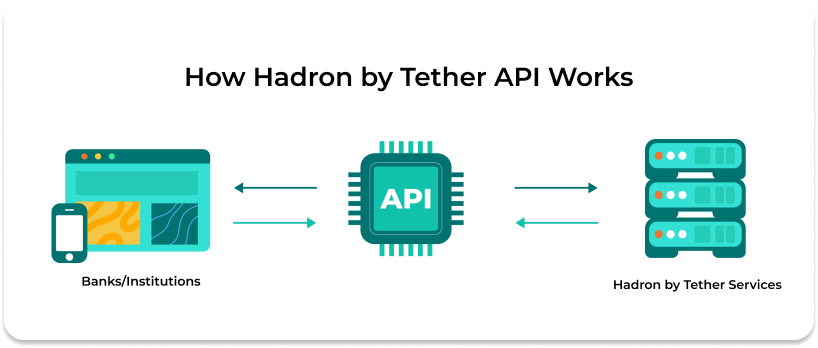
Hadron by Tether’s API offers a seamless bridge between traditional banking systems and tokenized real-world assets (RWAs).
APIs act as intermediaries between software systems, defining structured protocols that enable seamless communication, data exchange, and functionality integration. By standardizing interactions, they allow applications to request, send, and process information efficiently. Whether retrieving data from a remote server, integrating third-party services, or automating workflows, APIs ensure interoperability and scalability in modern software ecosystems.
For businesses and financial institutions, APIs enable seamless third-party service integrations, allowing for connections with payment gateways, fraud detection systems, and compliance platforms. By automating workflows and reducing manual intervention, they improve efficiency, minimize errors, and enhance customer experiences. Additionally, robust API security measures, such as authentication and encryption, help protect sensitive financial data and mitigate cyber threats.
How Our API Works
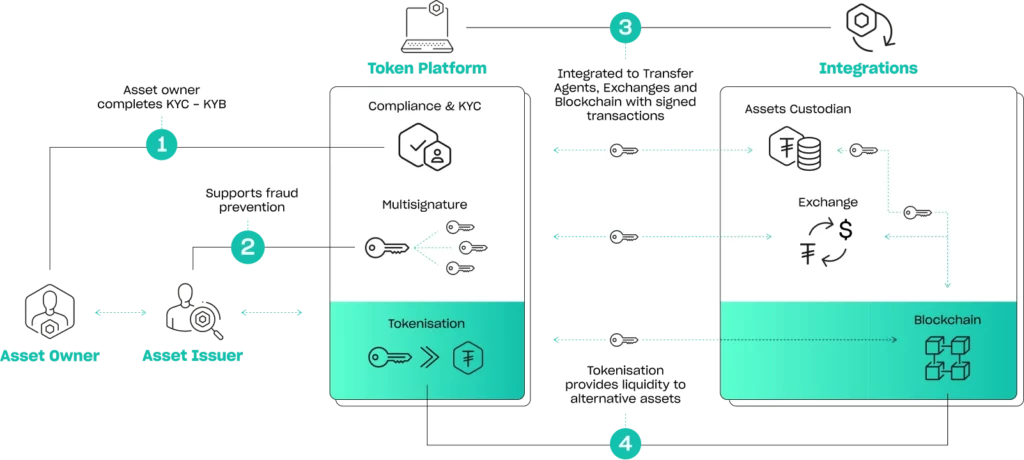
The Hadron by Tether API makes it easy for banks, financial institutions, and businesses to turn traditional assets, like corporate bonds or real estate, into digital tokens on the blockchain. The process is straightforward: they connect to the API, define the asset and issue and distribute tokens. Issuers can also remove tokens when necessary and transfer them instantly between accounts. For extra security, high-value transactions can require multiple approvals.
Compliance is simple too. The API includes tools to verify customer and business identities in real time, helping financial institutions and enterprises meet regulations without extra complexity. By doing so, it upholds the high security and transparency standards expected in blockchain technology while ensuring seamless and efficient operations.
Benefits of the Hadron by Tether API
Simplified Regulatory Compliance
The built-in KYC and KYB toolkit ensures that customer and business verification is seamless and secure. Banks can meet stringent regulatory requirements without added complexity, reducing compliance costs and risks.
Cost-Efficient Operations
With issuance, burn, and transfer functionalities, the API automates asset management processes. This cuts down on manual work, accelerates transaction times, and lowers operational overhead, a win for efficiency-focused institutions.
Enhanced Security with MultiSig
Multi-signature deployments require multiple approvals for transactions, adding a robust layer of protection. Whether managing tokenized bonds or commodities, banks can operate with confidence, knowing assets are safeguarded against unauthorized access.
Boosted Liquidity for Alternative Assets
Tokenizing assets like real estate or venture funds transforms illiquid holdings into tradable digital tokens. This fractionalizes ownership, opens markets to more investors, and enhances liquidity, unlocking value from previously static portfolios.
New Market Opportunities
By tokenizing a range of asset classes, banks can create innovative financial products, like tokenized equity funds or commodity-backed tokens. This attracts tech-savvy investors and taps into the growing digital asset economy, driving revenue growth.
Why This Matters Now
Customers and businesses are looking for more ways to access digital assets. Despite that, traditional financial systems are not set up to accommodate the growing market, and are often slow and expensive. The Hadron by Tether API offers a faster, more transparent solution, allowing financial institutions and businesses to modernize without replacing their entire system. Implementing the API allows businesses to expand their offerings by tokenizing assets like stocks or real estate, accelerating transactions and attracting a broader client base of investors seeking innovative financial solutions.
A Tokenized Future
Hadron by Tether gives banks, financial institutions, and businesses the tools to manage digital assets securely, stay compliant, and improve efficiency, without institutional restructuring. Tokenization increases liquidity and unlocks new market opportunities, giving businesses a competitive edge. As blockchain continues to reshape finance, we help financial institutions stay ahead—leading the way rather than catching up.
Real world asset (RWA) tokenization is the process of converting real-world assets like dollars, financial securities, real estate, or commodities into digital tokens on a blockchain, enabling cheaper, faster, and more accessible assets.
With growing demand for financial efficiency, market accessibility, and alternative investments, tokenized RWAs are expected to play an increasingly critical role in global financial markets. The ability to combine physical asset ownership with the speed and efficiency of blockchain technology is reshaping legacy financial systems.
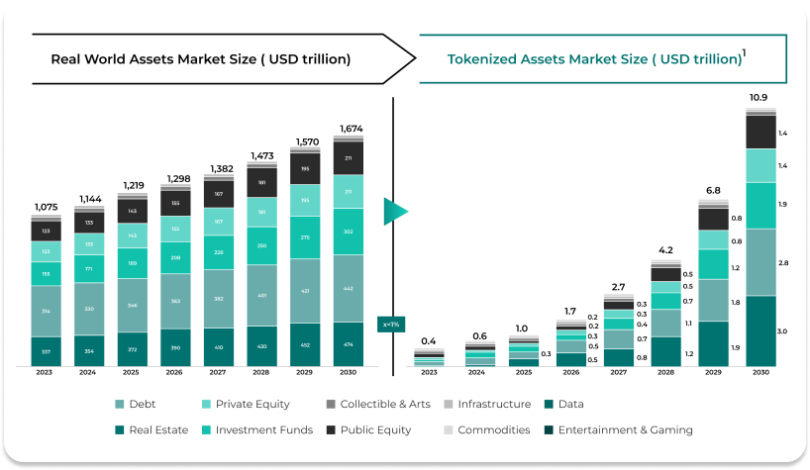
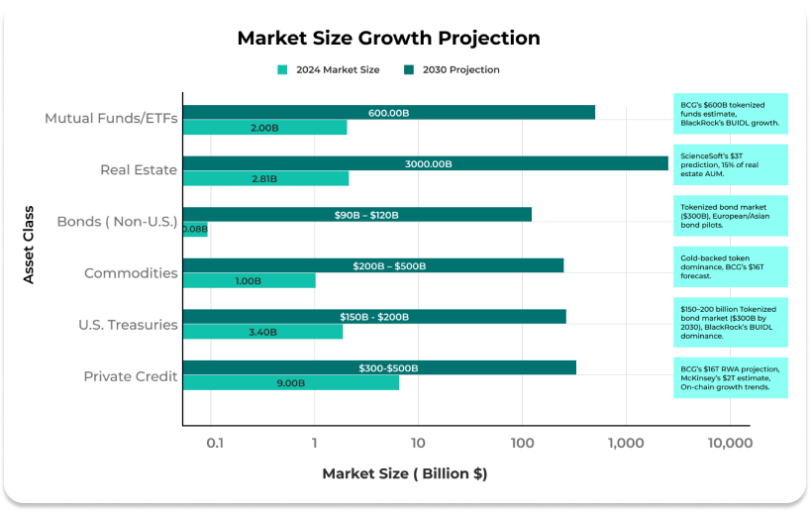
According to Roland Berger, the value of tokenized assets is projected to exceed $10.9 trillion by 2030, with real estate, debt, and investment funds leading as the top three tokenized asset categories.
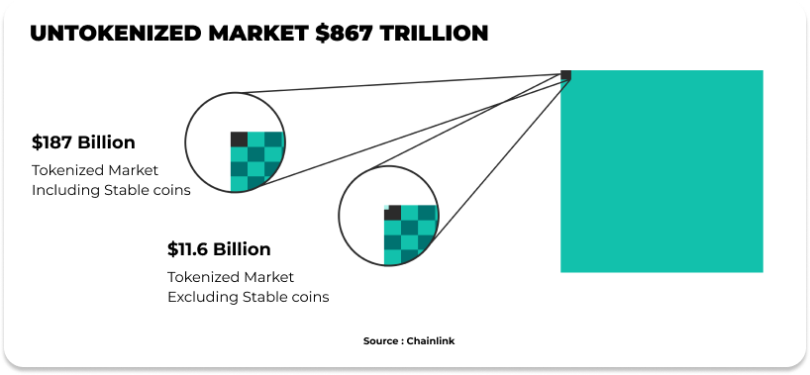
The global value of tokenized real-world assets stands at $867 trillion. As of November 2024, only 0.001346% of this value exists on-chain, highlighting the enormous potential for growth in asset tokenization.
Tokenized RWAs are poised to play a significant role in shaping the next generation of capital markets, helping to bridge the gap between traditional finance and digital assets.
Benefits of RWA
A major benefit of RWA tokenization lies in the ability to break down barriers in asset ownership. Historically, many of these assets were available only to institutional investors or individuals with significant wealth. Fractional ownership changes this by dividing valuable assets into smaller, tradeable units, making them accessible to a wider audience while preserving their underlying value.
Why Tokenize Real-World Assets?
Tokenizing RWAs provides solutions to several longstanding challenges in asset management and investment:
1. Fast 24/7 Transactions
Tokenization enables near-instant transaction via the blockchain, while enables markets to operates 24 hours per day, seven days per week, all year round.
2. Operational Efficiency
Smart contracts automate processes such as compliance checks, dividend distribution, and settlement, reducing reliance on intermediaries and lowering costs.
3. Transparency and Security
Tokenization ensures that every transaction is recorded on an immutable ledger, reducing the risk of fraud and providing clear ownership records.
4. Greater Accessibility
Assets like real estate or fine art, which traditionally take time to buy or sell, become more liquid when tokenized. Tokens can be traded in smaller increments, opening markets to more participants.
Use Cases of RWAs
Tokenized RWAs offer use cases across multiple markets and asset classes:
Stablecoins
Dollar-backed stablecoins provide a stable, liquid, and programmable asset for payments and remittances. They facilitate cross-border transactions, enhance liquidity in tokenized markets, and improve treasury management for institutions.
Private Credit
Tokenization enables broader investor participation in private credit markets by fractionalizing loan portfolios and making them tradable. This could increase access to capital for businesses while providing investors with a new source of yield.
US Treasuries
Tokenized treasuries offer near-instant settlement and 24/7 trading, making them more accessible to a global investor base. This enhances the potential liquidity in traditionally rigid fixed-income markets.
Non-US Bonds
Tokenization allows investors to gain exposure to international fixed-income assets with reduced transaction costs and streamlined settlement processes. It could also help issuers tap into a wider, more diverse investor base.
Commodities
Tokenization has introduced precious metals like gold and agricultural products into the hands of retail investors. Gold-backed tokens like Tether Gold allow smaller investments in a historically stable asset.
Real Estate
Property tokenization enables fractional investment, providing access to high-value properties. By removing intermediaries and automating transactions, tokenized real estate improves market efficiency and lowers costs.
Mutual Funds/ETFs
Tokenization of these securities also enhances liquidity and simplifies settlement, enabling greater market participation.
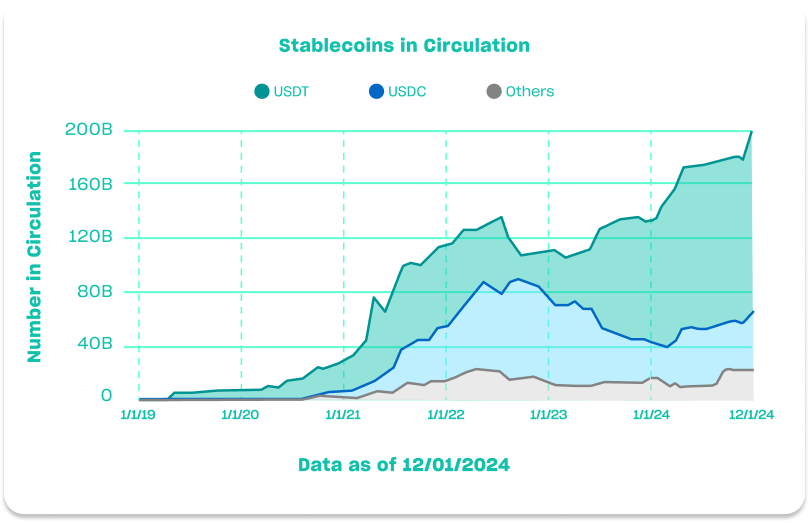
The global market for stablecoins is rapidly expanding, with over 100 million users now utilizing these digital assets across various platforms. The number of wallets holding stablecoins increased by 15% from January to April 2024, highlighting the growing adoption and trust in these currencies. There is significant room for established institutions to innovate and capture market share by issuing their own asset-backed stablecoins.
Stablecoins provide financial institutions a strategic advantage by enabling faster transactions, reducing costs, and enhancing security, especially in cross-border payments where they bypass slow, costly traditional banking systems.
Issuing stablecoins enables financial institutions to access new markets and serve underbanked populations, driving financial inclusion and positioning them as leaders in the digital economy.
As of November 1, 2024 there were over $162 billion of stablecoins in circulation. The most popular is USDT – issued by Tether, with over $120 billion in circulation.
Background
The global financial system is undergoing significant changes as markets become more complex and the demand for modernization grows. Major drivers behind this include increasing demand for digital assets and alternative assets, especially among younger generations. Meanwhile, the greatest wealth transfer in history is occurring. By 2045, $84.4 trillion is projected to shift from older to younger generations.
Financial institutions are facing the challenge of integrating traditional instruments with these emerging digital assets. Stablecoins have become an essential tool, offering a stable, digital alternative to conventional currencies that can be utilized across various financial services
Stablecoins enable financial institutions to increase transaction efficiency, lower costs, and improve access to global markets. As the digital economy continues to expand, these digital assets are becoming crucial for large organizations striving to stay competitive and enhance profitability.
Just as traditional financial infrastructures were developed to support the needs of growing economies, stablecoins represent the next generation in financial markets. By offering a dependable, asset-backed digital currency, established institutions can use stablecoins to optimize liquidity, streamline cross-border transactions, and expand their service offerings to better meet the needs of a global and increasingly digital customer base.
Main Drivers for Change
Research has isolated five (5) main reasons for the rapid adoption of stablecoins among users and financial institutions:
1. Growing Market Demand
The stablecoin market is expanding rapidly, with increasing user adoption and a growing number of wallets, highlighting their acceptance as a reliable digital currency.
2. Faster, For Less
By reducing intermediaries and simplifying processes, stablecoins enable near-instant transactions. This significantly improves efficiency and lowers costs for trading, remittances, domestic and cross-border payments.
3. Increased Security and Transparency
Blockchain’s decentralized nature provides enhanced security against fraud and ensures transparent, traceable transactions for regulatory compliance.
4. Financial Inclusion
Stablecoins extend financial services to unbanked and underbanked populations opening new markets for financial institutions.
5. Liquidity Management
Stablecoins provide a stable value, making them a reliable tool for liquidity management and a preferred means of exchange within financial systems.
Business Model
Hadron by Tether Real World Asset (RWA) Tokenization Platform
The business model for stablecoin issuance by financial institutions is built upon leveraging existing assets to create a profitable and scalable system. This model revolves around issuing stablecoins backed by the institution’s assets, such as government treasuries, to meet the growing demand for digital currency.
Asset Utilization and Interest Rate Impact
By issuing stablecoins, financial institutions can attract more users into their network and increase profitability. These assets can be invested in low-risk, high-yield government treasuries, creating a steady revenue stream. The profitability of this model is sensitive to interest rate fluctuations:
Rising Interest Rates: When interest rates increase, the returns from treasuries also rise, enhancing the yield on the assets backing the stablecoins.
Falling Interest Rates: Lower interest rates may decrease the yield from treasuries, but this is often offset by increased velocity and demand for stablecoins as more users turn to them for transactions due to the stability and low transaction costs.
Facilitating Transactions and Reducing Costs
Stablecoins offer significant advantages for peer-to-peer (P2P), business-to-business (B2B), and business-to-consumer (B2C) transactions, particularly in international markets. For example, a Brazilian company purchasing goods from Vietnam currently faces multiple currency conversions, foreign exchange (FX) charges, and time delays through the traditional banking system. By contrast, stablecoins allow for instant settlement with minimal fees, as both parties transact in a digital dollar that is stable and universally accepted.
Expanding Access to Financial Products
Beyond transaction facilitation, stablecoins open new avenues for financial institutions to offer yield and credit products. More and more small and medium-sized businesses (SMBs) in international markets choose stablecoins to settle transactions, recognizing the benefits of speed, cost-efficiency, and stability. This trend creates opportunities for financial institutions to provide services such as payroll solutions, lending, and investment products tailored to the needs of these businesses.
Current Market Adoption
The market for stablecoins is rapidly expanding, with $7 trillion in value settled through stablecoins in 2023 alone, according to Coinmetrics. Companies like BVNK have settled $6 billion in global B2B transactions using stablecoins, and major financial services providers such as Visa, PayPal, and Stripe have launched their own stablecoin solutions. A MasterCard study further highlights that one in three merchants in Latin America already transact in stablecoins, underscoring the growing adoption and demand.
Incorporating stablecoin issuance is not just profitable for financial institutions, it’s a must to stay competitive and aligned with the global shift towards digital assets. By leveraging existing assets, institutions can capitalize on the growing demand for stablecoins.
B2B Use Cases
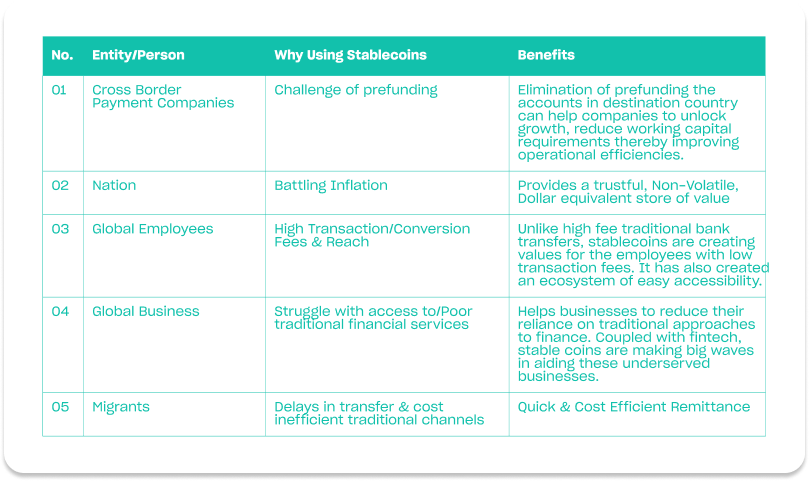
Stablecoins offer B2B solutions that surpass traditional financial systems in speed, efficiency, and cost savings. Three key applications demonstrate their transformative impact on business operations:
1. Distribution Channel to New Users
Leading financial institutions are faced with the challenge of attracting younger generations of investors. The generational wealth transfer, involving tens of trillions of dollars, is driving a shift in investor preferences. Millennials and Gen Z, set to inherit this wealth, favor digital assets and tech-driven financial solutions. By integrating stablecoins into their offerings, financial institutions can attract tens of millions of new users.
Old way: Investors from the generation of Boomers and Gen X prefer to deposit their funds into brokerages or purchase Money Market Funds.
New way: Investors from the Generation of Millenials and Gen Z prefer to deposit their funds into digital asset exchanges or purchase tokenized assets.
2. Merchant Settlements
For fintech companies that move money on behalf of their merchants, the ability to settle transactions quickly and reliably is a critical competitive advantage. Stablecoins are designed for speed – allowing payment providers to offer faster settlement times compared to traditional systems like SWIFT, especially for cross-border transactions. This not only speeds up the payment process but also reduces the need for holding capital in pre-funded accounts.
Old Way: Traditionally, fintech companies collect payments in local currencies, convert them to euros, dollars, or pounds, and then transfer the funds to merchants via SWIFT. This process typically takes 2-5 days for funds to settle.
New Way: By converting fiat currency to stablecoins, fintech companies can send funds directly to the stablecoin wallet of an international merchant within minutes. This method is already being tested by some of the world’s largest payment companies, including Visa, Worldpay, and Nuvei.
3. Payouts
Stablecoins offer a unified solution for various payout needs, including merchant settlements, consumer refunds, withdrawals, winnings, and salary payments. This approach is particularly advantageous in regions where traditional methods are slower, costly, and less reliable.
Old Way: Fintech companies and businesses traditionally processed payouts through payment cards, bank accounts, digital wallets, or mobile money apps. These transactions, especially for international payments, often took days to settle and incurred high fees. Currency conversions were also a challenge, particularly in volatile markets, leading to potential losses in value for recipients.
New Way: With stablecoins, payouts can be made within minutes and cost-effectively. Whether settling merchant transactions, issuing consumer refunds, or paying contractors, stablecoins eliminate the need for currency conversions and reduce fees. This new method offers recipients the option to hold digital dollars, providing stability in volatile markets and significantly speeding up the payment process.
Individual Use Cases Note
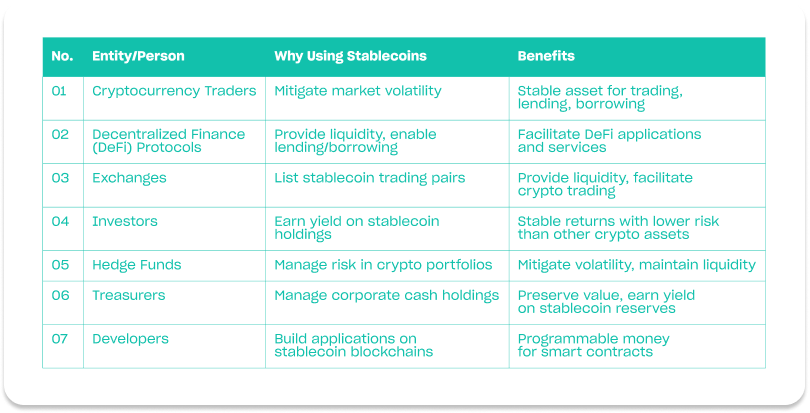
Here are some of the key ways in which individuals are leveraging stablecoins:
Financial Inclusion & Global Access:
Stablecoins provide individuals with a secure way to participate in international financial markets, enabling them to engage in global debt and credit transactions. These financial services might otherwise be out of reach.
Secure & Stable Currency:
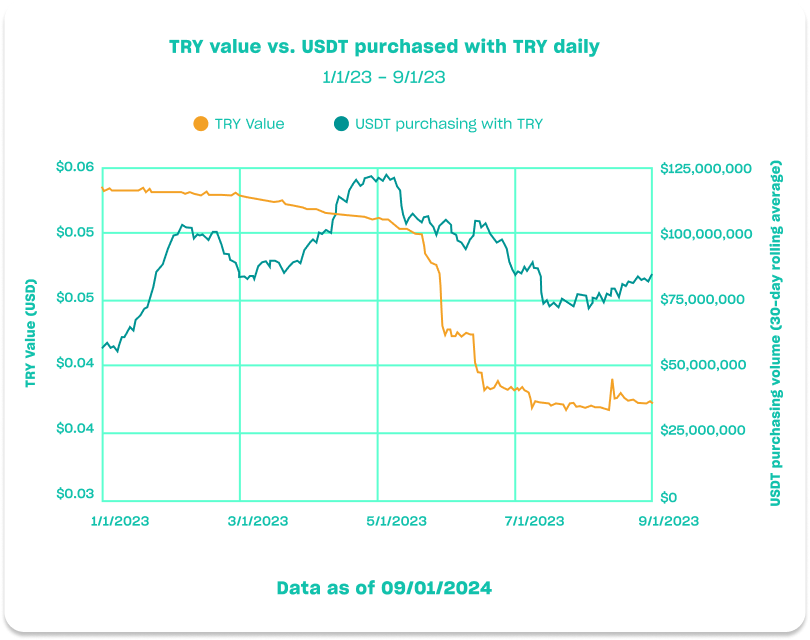
Many individuals use stablecoins to store value, especially in regions where local currencies are unstable due to censorship, inflation, or other economic issues. For example, in Turkey in 2023, citizens were selling nearly $100mm of Turkish Lira monthly to buy and hold USDT.
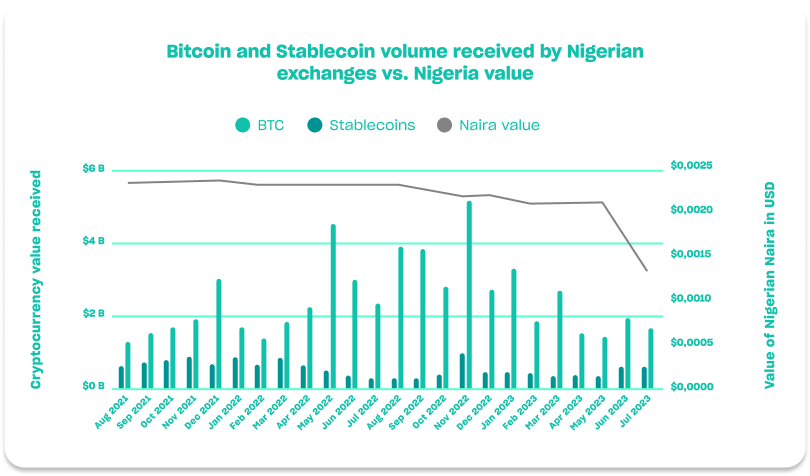
In 2022 & 2023, similar trends appeared across locations such as Nigeria, Vietnam, Ukraine and multiple countries in Latin America and sub-Saharan Africa. Stablecoins became the most used cryptocurrency in these locations, as they offered both price stability and utility.
Alternative to Traditional Financial Systems:
Accessing dollars through conventional banking channels can be expensive and complicated. Stablecoins offer a more accessible and cost-effective alternative.
Rapid & Low-Cost Remittances:
Stablecoins can be easily acquired and transferred over the internet. Individuals use stablecoins to send and receive remittances across borders quickly and at a lower cost compared to traditional methods.
Looking Ahead
As the global financial system evolves, stablecoins are set to play a crucial role for large institutions. By adopting stablecoin issuance, these organizations can enhance efficiency, access new markets, and offer faster, more cost-effective transactions. This positions stablecoins as a key driver of profitability and market expansion. Financial institutions and established organizations that integrate stablecoins will benefit from customer acquisition, cost savings, and a stronger competitive edge, while also supporting global trade and financial inclusion. Embracing stablecoins is essential for leading in a rapidly digitizing world.
About Hadron by Tether
Hadron by Tether is an asset tokenization platform that simplifies the process of converting various assets into digital tokens. With its seamless and intuitive interface, the platform allows users to easily tokenize stocks, bonds, commodities, funds, and reward points. This opens up new opportunities for individuals, businesses, and even nation-states to raise funds using tokenized collateral.
The platform offers a range of tools, including asset issuance and burning, KYC (Know Your Customer) compliance, blockchain reporting, capital market management, and regulatory guidance. By making asset tokenization more accessible, Hadron by Tether aims to revolutionize the finance sector and shape the future of money.
Tokenization is redefining asset ownership, accessibility, and trading in financial markets. As tokenization progresses, it has the potential to unlock tremendous value in the commodities sector, empowering a wider range of investors to participate in markets that can offer both resilience and growth potential. The tokenized commodities industry is young and rapidly expanding, with a market size of ~$1.3 billion as of November 2024 and YoY growth of ~25%
By creating digital tokens that represent physical assets such as precious metals, energy commodities, and agricultural products, issuers have the potential to create broader investment access and market participation. This approach could introduce greater liquidity and transparency, enabling assets to be traded more freely on blockchain networks while reducing dependence on intermediaries. Fractional ownership allows investors to diversify their portfolios with digital real-world assets, leveraging the efficiency of blockchain technology.
Hadron by Tether is an asset tokenization platform that simplifies the process of converting various assets into digital tokens. With its seamless and intuitive interface, the platform allows users to easily tokenize stocks, bonds, commodities, funds, and reward points. This opens up new opportunities for individuals, businesses, and even nation-states to raise funds using tokenized collateral.
Background
The shift towards tokenized assets is reshaping the financial landscape, particularly within the commodities sectors. Tokenization allows traditional assets—such as precious metals, energy commodities, and agricultural products—to be divided into digital tokens that represent ownership. This new approach enables broader market access, enhanced liquidity, and real-time trading capabilities on blockchain networks, a structure that was previously limited to specific financial institutions and high-net-worth investors. Global demand for alternative assets is increasing rapidly, driven by investors seeking diversification and stability in uncertain economic environments. Tokenized commodities provide a bridge between physical assets and digital finance, offering investors secure, divisible ownership in real assets. In leveraging blockchain technology, tokenized commodities provide enhanced transparency by recording every transaction on an immutable public ledger, ensuring security through decentralized validation, and improving efficiency through faster, lower-cost transactions without the need for intermediaries. Our platform supports these transitions by providing a unified framework for tokenized asset issuance and management, designed to integrate seamlessly with existing financial structures.
Main Drivers for Change
1. Demand for Diversification and Stability
With global markets increasingly impacted by economic and geopolitical uncertainty, there is a growing demand for alternative investment options. Commodities offer an alternative investment vehicle to traditional bonds and equities. Some commodities can act as a store of value or serve as a hedge against volatility in traditional markets. Tokenization democratizes access to these assets, which are now available at a fraction of the cost, allowing retail investors to participate alongside institutions. An example of this is Tether Gold ($XAUT) which sees over $6mm in daily trading volume, as of November 2024.
2. Rapid Settlement and Operational Efficiency
Blockchain technology has introduced new levels of transparency, security, and efficiency in asset management. Tokenized assets are recorded on immutable ledgers, reducing reliance on intermediaries and enabling faster, cost-effective transactions. For example, commodity ETF’s are usually settled in one business day (T+1) whereas gold backed stable coins like $XAUT are settled instantaneously or within couple of minutes. Hadron by Tether’s multi-chain architecture provides institutions with flexible, scalable solutions to manage these digital assets, making it easier for both large institutions and individual investors to access and trade these commodities, with settlement in real-time 24/7/365.
3. Growing Institutional and Retail Interest in Real-World Asset (RWA) Tokenization
Tokenization platforms are gaining traction among institutions that want to manage assets digitally while still retaining exposure to tangible, real-world assets. Our platform supports commodity-backed tokens, enabling banks, investment funds, and retail investors to engage with assets like gold, oil, and agricultural products in ways that enhance liquidity and expand market accessibility.
4. Enhanced Financial Inclusion
Tokenization allows fractional ownership, which makes trading logistically easier for retail investors thus lowering the barrier to entry for individual investors to own assets that were previously out of reach. By enabling retail participation in assets like precious metals and agricultural commodities, tokenization supports a more inclusive financial system, extending investment opportunities to a wider audience.
Hadron by Tether: The Technology Behind Tokenized Capital Markets
Hadron by Tether Real World Asset (RWA) Tokenization Platform
Integration, Comprehensive Technology Platform
Hadron by Tether provides institutions with the tools they need to help them facilitate secure, compliant and efficient transactions in a modern digital economy.
The platform is integrated with leading blockchains, allowing for seamless customization. This includes Liquid, a Bitcoin sidechain that leverages Bitcoin’s proven architecture to help ensure the secure tokenization of real-world assets. Liquid’s established code base preserves the essential security features of the Bitcoin blockchain, providing a reliable foundation for global capital markets.
Our multi-chain architecture means seamless interoperability, enabling issuers a high level of customization in applying specific requirements. This flexibility empowers issuers to tailor their offerings to meet its regulatory and market needs, further enhancing Hadron by Tether’s utility.
New Capital Markets with Tokenized Commodities
Tokenizing commodities enables institutions, exchanges, and governments to create more transparent and efficient capital markets by transforming traditionally illiquid assets into accessible, tradable forms. With tokenized commodities, institutions can unlock capital for critical projects and drive sustainable growth in both established and emerging markets. By tokenizing real-world assets, Hadron by Tether empowers partners to build diversified ecosystems that attract global investors, stimulate economic development, and support long-term prosperity.
Tokenized Commodities: Current & Potential Use Cases
1. Tether Gold (XAU₮)
Tether Gold enables investors to own physical gold on the blockchain, combining the security of a stable, real-world asset with the flexibility of digital tokens. Each XAU₮ token represents ownership of one troy ounce of physical gold, and the gold is stored in secure Swiss vaults. XAU₮ addresses storage and transaction limitations of physical gold while providing fractional ownership and 24/7 liquidity. This asset operates independently of traditional markets, making it accessible even when conventional gold exchanges are closed, thus broadening investment options for retail and institutional investors.
2. Precious & Industrial Metals
Tokenization of precious metals allows secure, divisible ownership of assets previously reserved for high-net-worth individuals and institutions. As of November 2024, gold tokens account for around 90% of all tokenized commodities, with a market capitalization of ~$1.17B. In addition to gold tokens like Tether Gold, tokenization could be applied to other precious metals such as silver, platinum and palladium whose combined annual market size is over $30 billion. This would also apply to industrial metals such as aluminum, copper and nickel. This would enable investors to buy fractions of metal units, broadening access and offering a stable asset class within the digital finance ecosystem. The ability to trade precious metals 24/7 on blockchain networks enhances liquidity and provides a reliable store of value for both institutional and retail investors.
3. Oil and Energy Commodities
Tokenizing energy commodities, such as oil and natural gas, introduces new liquidity and democratizes access to traditionally exclusive markets. By removing intermediaries, Hadron by Tether allows investors to hold fractional shares in energy reserves, reducing transaction costs and enhancing transparency. Additionally, tokenized carbon credits provide incentives for sustainable energy practices, allowing institutions to create and trade digital tokens representing emissions reductions.
Potential features of oil/energy tokens:
Tokenization of mineral rights: allowing landowners to sell the rights to oil beneath their land without giving up ownership of the land itself. Royalty distribution: Oil companies lease these mineral rights and pay a share of their profits to the rights’ owners. For example, if an oil operator produces $1 million worth of oil in a month, they distribute 25% to the mineral rights’ owners. Yield potential: A token issuer could offer a tokenized fund owning mineral rights on land operated by an oil & gas company, and offering a specified yield.
4. Agricultural Products
Tokenizing agricultural commodities, including crops, carbon credits, and livestock, supports transparency and traceability in the agricultural supply chain. With Hadron by Tether’s infrastructure, investors can own fractional shares in agricultural products, making it easier for institutions to promote sustainable farming practices. Tokenized agricultural assets are ideal for socially responsible investors, enabling sustainable funding mechanisms for farms while providing a stable source of income through dividends or yield farming.
Potential features of agricultural tokens:
Tokenization of major crops such as soybeans, corn, wheat, coffee and sugar cane offer investors a new channel to access agricultural investments. Each token would be backed by and represents one ton of grain, or similar unit. Tokenization allows farmers to store, invest, and transact with their grain production, potentially removing intermediaries and reducing costs This can provide small and medium-sized farmers with access to new funding sources through tokenized assets.
5. Integration with Decentralized Finance (DeFi)
Hadron by Tether can be integrated into DeFi platforms, enabling new financial strategies, such as collateralized loans, yield farming, and asset-backed stablecoin issuance. Tokenized assets such as gold and oil offer an alternative form of collateral, making DeFi accessible to investors looking to diversify outside of crypto assets. This approach enhances portfolio diversification while providing liquidity and risk management options that were previously unavailable in traditional finance.
About Hadron by Tether
Hadron by Tether is an asset tokenization platform that simplifies the process of converting various assets into digital tokens. With its seamless and intuitive interface, the platform allows users to easily tokenize stocks, bonds, commodities, funds, and reward points. This opens up new opportunities for individuals, businesses, and even nation-states to raise funds using tokenized collateral.
The platform offers a range of tools, including asset issuance and burning, KYC (Know Your Customer) compliance, blockchain reporting, capital market management, and regulatory guidance. By making asset tokenization more accessible, Hadron by Tether aims to revolutionize the finance sector and shape the future of money.